

How to Stay Fit When Your Job Keeps You Seated All Day
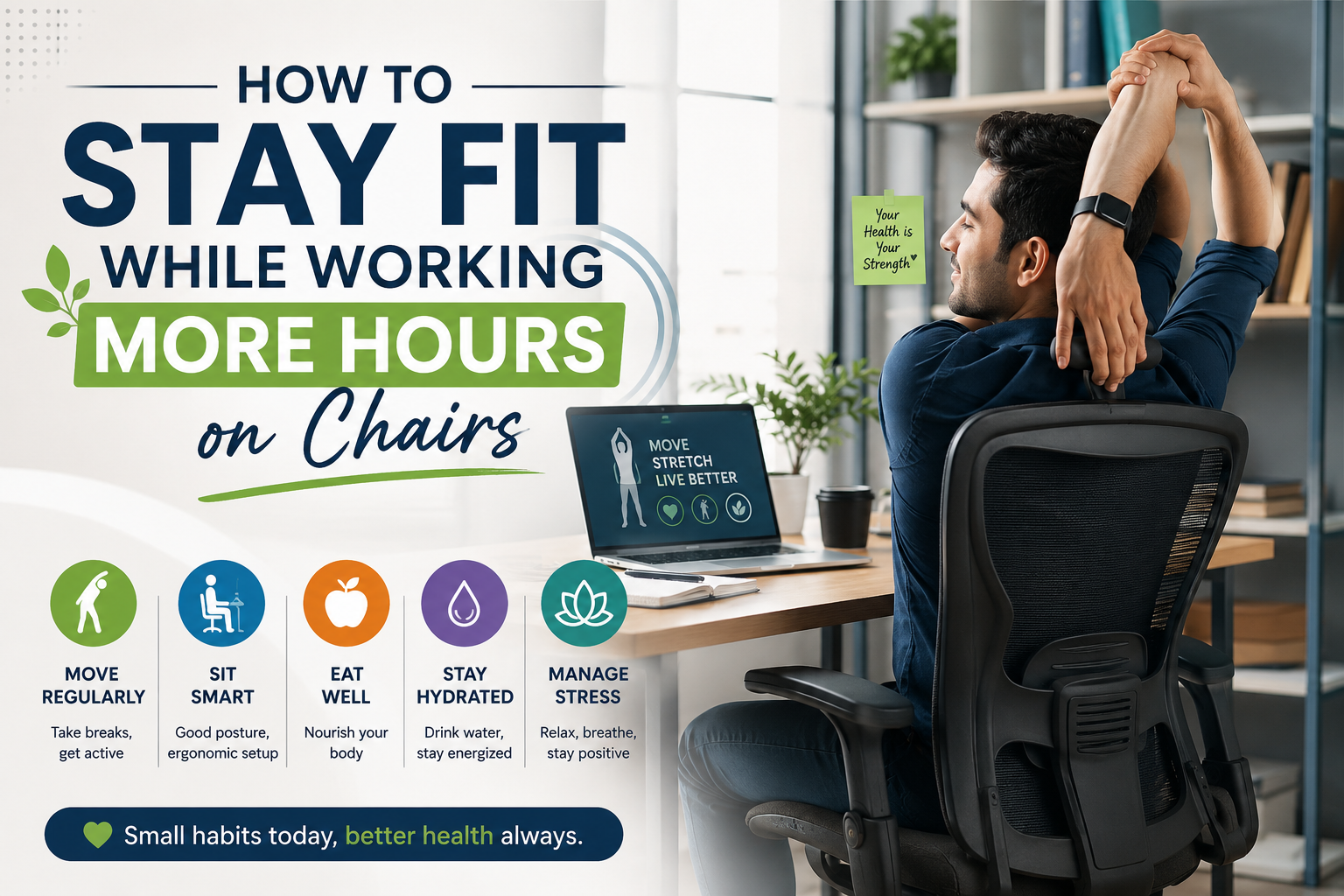
By a person who has personally stared at a screen for ten hours straight and paid the price.
There is a particular kind of tired that comes from sitting too long. It is not the satisfying, heavy tiredness you feel after a long hike or a solid gym session. It is a dull, spreading stiffness that starts somewhere around your lower back, creeps up your neck, and eventually settles behind your eyes like a fog that refuses to lift. Your legs feel restless and sluggish at the same time. Your shoulders have crept toward your ears without you noticing. You stood up to get a glass of water and felt, for a moment, like your hip flexors had quietly given up on you.
This is the reality of working long hours at a desk. It is not dramatic. It does not announce itself. It accumulates quietly, day after day, until one morning you realize that you are thirty-four years old and your back sounds like bubble wrap when you twist.
The good news is that this does not have to be your story. You do not need to quit your job, become a personal trainer, or start waking up at 4:30 in the morning to run ten miles before sunrise. What you need is an honest, practical understanding of what happens to your body when it sits for long stretches, and a set of real, doable habits that can actually fit inside the life you already have.
This is that guide.
Why Sitting for Long Hours Actually Hurts You
Before we get into solutions, it helps to understand the problem clearly, because once you see what extended sitting does to your body, the motivation to change becomes a lot more personal.
When you sit for a long period of time, your hip flexors shorten and tighten. These are the muscles that connect your spine and pelvis to your thighs, and they are designed for movement. When they are locked in a bent position for hours, they start to adapt to that position. Over time, this leads to an anterior pelvic tilt, which is a fancy way of saying your pelvis tips forward, your lower back arches excessively, and your glutes essentially forget how to do their job properly. That is not just a posture issue. That is a source of chronic lower back pain for millions of desk workers.
Your hip flexor tightness is not the only problem. Your thoracic spine, which is the mid and upper portion of your back, was built for rotation and extension. Sitting hunched over a screen all day compresses it into flexion. Your chest muscles shorten. Your upper back muscles stretch and weaken at the same time. The result is that rounded-shoulder, forward-head posture that has become so common it almost looks normal. But it is not normal, and it contributes to neck pain, shoulder impingement, and headaches that no amount of ibuprofen will fully fix because they are structural, not chemical.
Then there is the metabolic side of things. When your large muscle groups are not contracting, your body's ability to regulate blood sugar slows down. Your circulation becomes sluggish. Research has consistently linked prolonged sitting with increased risk of cardiovascular disease, type 2 diabetes, and even certain cancers, regardless of whether a person exercises at other times of the day. That last part is important. You cannot fully counteract eight hours of sitting with a single thirty-minute workout. The activity needs to be distributed across the day in a way that keeps your body regularly engaged.
None of this is meant to terrify you. It is meant to be honest. The body is remarkably adaptable, and with the right habits, most of these effects can be prevented or even reversed. But the habits have to be consistent, and they have to be built into your actual day, not reserved for some theoretical future when things calm down and you finally have time.
The Movement Principle You Actually Need to Know
There is one idea that underpins all of the advice in this piece, and it is this: frequency matters more than duration when you are trying to counteract the effects of a sedentary job.
A thirty-minute workout in the morning is genuinely valuable. But thirty minutes of concentrated exercise followed by eight more hours of sitting is not the same as thirty minutes of exercise spread across the day in short bursts, with regular movement breaks in between. The second approach keeps your metabolism more active, reduces the compressive effects on your spine, maintains circulation in your legs, and gives your muscles regular reminders that they exist and have a job to do.
This does not mean you need to stop work every twenty minutes and do a full stretching routine. Small, consistent interruptions to prolonged sitting are enough to make a real difference. We will talk about what those look like in a moment.
Build Your Day Around Movement, Not Around Finding Time for Movement
Most people think about fitness as something they need to find time for. They look at their packed schedule, feel guilty about not exercising, and then feel helpless because there genuinely does not seem to be a gap in the calendar. The problem with this framing is that it treats movement as something separate from life, an add-on that requires a dedicated block.
A more effective approach is to stop looking for time to exercise and start designing your day so that movement is woven into it continuously. This is not about lowering your standards. It is about recognizing that a body that moves regularly throughout the day is healthier than one that sits for ten hours and then goes to the gym.
Here is how that design can look in a real workday.
Set a Movement Timer and Actually Use It
This is the single most effective habit for desk workers, and it costs you almost nothing in terms of time or effort. Every forty-five to sixty minutes, stand up and move for two to five minutes. That is it.
The movement does not need to be elaborate. Walk to the kitchen and back. Do ten bodyweight squats next to your desk. Stand and do some slow neck rolls and shoulder circles. Walk outside for two minutes. Do a brief hip flexor stretch in your doorway. The specific movement matters less than the fact that you are breaking the sitting posture and asking your body to do something different.
The challenge is that when you are deep in focused work, forty-five minutes disappears in what feels like five. This is why you cannot rely on remembering. Set a timer. There are desktop apps designed for this purpose, or you can use any basic timer on your phone. Some people use the Pomodoro technique, which structures work in twenty-five minute focused blocks followed by five-minute breaks, and find that it helps with both their productivity and their movement throughout the day.
Over the course of an eight-hour workday, these breaks add up to somewhere between twenty and forty minutes of additional movement that you would not otherwise have. That is meaningful.
Make Your Desk Setup Work For Your Body
Before we talk about exercise, it is worth spending a few minutes on your physical workspace, because a poorly set-up desk can undo a lot of the good work you put in elsewhere.
Your monitor should be at eye level. If you are consistently looking down at a laptop screen, you are putting your neck in a position that adds significant compressive load to your cervical spine. The fix is simple: a laptop stand, a stack of books, or an external monitor at the right height. Pair it with an external keyboard and mouse, and your posture options improve enormously.
Your chair height should allow your feet to sit flat on the floor and your knees to be roughly level with your hips. If your chair is too low, your knees will be higher than your hips, and your lower back will round. If your chair is too high, you will end up perching or letting your feet dangle, neither of which is sustainable.
Your lower back should have support. If your chair does not provide it naturally, a small cushion or rolled-up towel placed at the curve of your lumbar spine can make a significant difference in how you feel at the end of a long day.
None of this requires expensive ergonomic furniture, though that helps if you have access to it. A few small adjustments to what you already have can go a long way.
If you can access or afford a standing desk, use it. Standing all day is not the goal, and it comes with its own issues if done without breaks. But alternating between sitting and standing throughout the day is one of the most effective ways to reduce the negative effects of extended desk work. Even a simple adjustable desk converter that sits on top of your existing surface can make a real difference.
Stretch the Parts That Tighten Most at a Desk
You do not need a full yoga practice to undo the damage of desk work. You need to know which muscles are most affected and give them regular attention. These are the main ones.
Your hip flexors are the most chronically shortened muscles in a desk worker's body. A basic kneeling hip flexor stretch, where you kneel on one knee and push your hips forward gently, held for thirty to sixty seconds on each side, will do more for your lower back comfort than almost anything else. Do this at least once during your workday and again in the evening.
Your chest and front shoulders tighten from the forward-reaching position of typing and mousing. Stand in a doorway, place your forearms on either side of the frame, and gently lean forward until you feel a stretch across the front of your chest. Hold for thirty seconds. Do this a few times a day. It counteracts the rounded-shoulder position that causes so much upper back and neck pain.
Your thoracic spine needs rotation and extension. A simple way to work on this is to sit at the edge of your chair, clasp your hands behind your head, and gently extend your upper back over the backrest of the chair, looking up at the ceiling. This mobilizes the part of your spine that gets most compressed during desk work. You can also do a seated thoracic rotation by sitting up tall, crossing your arms over your chest, and rotating gently to the left and right, going only as far as feels comfortable.
Your neck carries an enormous amount of tension during focused work. Slow, gentle neck rolls, ear-to-shoulder tilts, and chin tucks are all valuable. A chin tuck, where you gently pull your chin straight back as if you are trying to make a double chin, is particularly effective for counteracting the forward-head posture that develops from looking at screens.
Your glutes and hamstrings are often both tight and weak in desk workers because they spend so much time being compressed and underused. A simple figure-four stretch, where you sit with one ankle crossed over the opposite knee and gently lean forward, will stretch your piriformis and glute in a way that is deeply satisfying after a long sitting session.
The Short Workout That Actually Gets Done
One of the main reasons people with long working hours stop exercising is that they feel like anything less than a full workout is not worth doing. This is one of the most self-defeating beliefs in fitness, and it is worth examining directly.
A ten-minute workout done consistently, five days a week, is incomparably better for your health than the perfect hour-long workout that happens twice a month when conditions align. Volume matters, but consistency matters more, especially for people managing full schedules.
If you have a demanding job and limited time, here is a framework that works in the real world.
On the days when you genuinely only have ten to fifteen minutes, do something that targets the movement patterns most relevant to what your body needs after sitting. Bodyweight squats wake up your glutes and hip flexors. Hip hinges, like Romanian deadlifts with no weight or with whatever you have at home, train the posterior chain that gets so neglected at a desk. Push-ups counteract the chest-tightening effect of typing all day. A plank or dead bug exercise builds the core stability your lower back is quietly craving. A set or two of each of these, done a few times a week, will make a tangible difference in how your body feels.
On the days when you have thirty minutes or more, use them well. This might be a run, a gym session, a cycling class, a swim, or whatever form of movement you genuinely enjoy. The form matters less than the fact that you are doing it. People who enjoy their exercise are the people who keep doing it. If you hate running, do not build your fitness plan around running. Find something that does not feel like punishment.
The key is to stop treating the long workout and the short workout as belonging to different categories. They are both exercise. They both count. The short ones are not consolation prizes. They are the glue that holds your fitness together on the days when life is full.
Walk More Than You Think You Need To
Walking is profoundly underrated as an exercise for desk workers, and it is one of the most accessible things you can do regardless of your fitness level, schedule, or equipment situation.
Walking engages your glutes and hip extensors in exactly the way that sitting does not. It promotes circulation in your lower limbs. It reduces cortisol. It improves mood. It burns calories without triggering the appetite response that more intense exercise sometimes does. And for many people, it is the only form of exercise that actually happens consistently, because it requires no preparation, no special clothing, and no particular location.
There are easy ways to add more walking into a desk-heavy day. Walk during phone calls instead of sitting at your desk. Take a ten-minute walk after lunch, not to burn calories specifically, but because post-meal walking significantly improves your body's blood sugar response to food. Walk to your colleague's desk instead of sending an email. Take the stairs. Park further away. If you work from home, build a short walk into the start or end of your workday as a transition ritual, something that separates work time from home time in the way a commute used to.
Even two thousand additional steps a day, spread across a workday, adds up to something genuinely meaningful over weeks and months.
Eat in a Way That Supports a Less Active Body
This is the part that people often find uncomfortable to hear, but it matters enormously. Your nutritional needs when you are sitting for eight to ten hours a day are simply different from your nutritional needs when you are physically active for much of the day. A body that is largely sedentary does not burn as many calories as an active one, and eating as if you are more active than you actually are will lead to gradual weight gain and the metabolic complications that come with it.
This does not mean eating very little. It means eating in a way that is appropriate to your actual activity level, with enough protein to maintain muscle mass, enough fiber to support digestion and gut health, and enough whole foods to keep your energy stable throughout the day instead of spiking and crashing.
One of the most common patterns among desk workers is eating a large lunch, feeling sluggish and sleepy in the early afternoon, then reaching for sugary or caffeinated things to push through, and then being too tired to exercise in the evening. Breaking this cycle usually starts with eating a lunch that is a bit lighter and better balanced, with enough protein and fat to maintain steady energy, and not so many refined carbohydrates that your blood sugar surges and then drops an hour later.
Staying hydrated throughout the day also matters more than most people realize. Even mild dehydration affects concentration, mood, and energy levels. Keeping water at your desk and drinking it consistently across the day is a small habit with a noticeable impact.
Snacking deserves a mention too. The desk environment is uniquely hostile to healthy eating because food is often used as a coping mechanism for stress, boredom, and the low-grade restlessness of staying mentally focused for long stretches. Being aware of this pattern, and having snacks available that do not derail your energy, things like a handful of nuts, a piece of fruit, or yogurt, can make a meaningful difference in how you feel and what you end up eating over the course of a day.
Sleep Is Not Optional
It would be irresponsible to write a guide about staying healthy in a sedentary job without talking about sleep, because sleep is the foundation on which everything else rests, and it is the thing that people in demanding jobs most reliably sacrifice first.
When you are sleep-deprived, your cortisol levels rise. Your hunger hormones become dysregulated, pushing you toward high-calorie, high-sugar foods. Your motivation to exercise drops. Your body's ability to recover from physical activity is compromised. Your concentration at work suffers, which means you end up sitting at your desk for even longer trying to accomplish the same amount of work. It is a self-reinforcing cycle that is very hard to break without addressing the sleep at the center of it.
Seven to nine hours of sleep is not a luxury. It is a physiological requirement. If you are consistently getting less than that because of your work schedule, the long hours are costing you more than you are probably aware of. Not just in terms of health, but in terms of the quality and efficiency of the work itself.
If you struggle with sleep, the basics are usually the place to start. A consistent sleep time and wake time, even on weekends. A bedroom that is dark, cool, and quiet. No screens for thirty minutes before bed, not because of the light alone, but because the mental stimulation makes it harder for your nervous system to downshift. And some form of wind-down ritual, even a brief one, that signals to your body that the workday is over.
The Mental Side of Staying Active When Work Is Consuming
There is a psychological dimension to this that does not get discussed enough. When your job is intellectually demanding and emotionally consuming, physical activity can start to feel like one more thing on a list that is already too long. The willpower required to drag yourself to the gym after a ten-hour day of difficult work often simply is not there. And then the guilt sets in, which adds stress, which makes recovery harder, which makes you less likely to exercise, and so on.
There is a way out of this loop, and it is not discipline. It is design.
The habits that survive long-term are the ones that require the least activation energy. If exercise requires driving to a gym, changing, working out, showering, and driving back, it requires a significant chunk of time and a meaningful amount of motivation. If exercise means doing twenty squats next to your desk, putting your shoes on and walking around the block, or doing a fifteen-minute yoga video in your living room, the barrier is low enough that you will actually do it on the hard days.
This is not about permanently lowering your fitness ambitions. On the days when you have more energy and time, you push harder. But the days when you are depleted need their own, simpler version of health maintenance, and having that version ready means you do not end up with nothing.
Building accountability also helps. A lunchtime walk with a colleague, a workout class with a friend, a simple habit tracker where you mark off your movement breaks. These small structures make it easier to stay consistent when motivation is unreliable, which is, honestly, most of the time.
Putting It Together: A Day in the Life
Here is what a genuinely achievable healthy workday might look like for someone with a long and demanding desk job.
You wake up and before you sit down at your computer, you spend five minutes moving. This does not have to be formal exercise. It can be stretching in bed, a short walk to the end of the street and back, or some gentle mobility work in your living room. The point is to wake your body up before you start a long sitting session.
During your workday, you have a timer set for fifty minutes. When it goes off, you stand up, move for two to three minutes, and then sit back down. Some of those breaks involve stretching. Some involve walking to another room. Some are just standing at your desk and shifting your weight while you look out the window.
At lunchtime, you eat something that is nourishing and not too heavy, and then you take a ten-minute walk before coming back to your desk. This is a non-negotiable part of your midday routine.
In the late afternoon, when your energy dips, you do five minutes of movement instead of reaching for coffee or sugar. This might be ten push-ups, a few minutes of stretching, or a brief walk. It is often enough to clear the fog and get you through the rest of the day without chemical assistance.
After work, you move your body in a way that feels good to you. On some days this is a proper workout. On others it is a walk with a podcast or a gentle yoga session. On the hardest days it is fifteen minutes of stretching on the floor while watching something you love. All of these count. All of them are part of a consistent practice.
You eat dinner that is balanced and not too late, you stay off screens for the last part of the evening, and you go to bed at a consistent time.
This is not a perfect day. There will be days when the timer gets ignored, when lunch gets eaten at the desk, when work runs so late that everything else falls away. That is normal and fine. The goal is not perfection. The goal is a consistent direction.
A Final Word
The culture around work has spent a long time telling us that prioritizing our health during working hours is self-indulgent, that breaks are for the less dedicated, that pushing through discomfort is a virtue. This is not only wrong, it is counterproductive. Bodies that are well cared for think more clearly, focus more easily, handle stress more gracefully, and sustain high performance over time. Bodies that are ignored until they break down do not.
You do not need to choose between being good at your job and taking care of yourself. In fact, the evidence strongly suggests that the two are far more complementary than they are in competition. Movement improves cognitive function. Sleep improves decision-making. Reduced physical pain reduces mental distraction. A body that feels capable and alive shows up differently at a desk than one that is stiff, exhausted, and running on caffeine.
You are not just a brain that needs to be transported from meeting to meeting. You are a whole person whose body needs to be treated like the complex, intelligent, remarkable thing that it is.
Start with one thing. Set a timer. Stretch your hip flexors. Take a walk after lunch. Sleep an extra thirty minutes. You do not have to overhaul your life to feel better. You just have to begin.